Driving
 “She’s a tank, alright.” The voice on the phone had said.
“Back in the sixties the engineers didn’t know how strong fiberglass could be, so they just kept pouring more and more resin into the mold.”
The Midwestern voice on the phone sounded to be weighing the effect of each word. Was the speaker hesitating because he was hiding something? Then I remembered that the voice sounded an awful lot like it was coming from my friend John.
Johnny Van Landeghem spoke like that, slow, measured, thoughtful, with a lot of pauses to think. The year we left high school Johnny and I paddled a sixteen-foot canoe from Winnipeg to New Orleans. I had trusted Johnny with my life. I decided to trust this voice.
The Midwestern voice said his name was Tim.
Even after I agreed to come and see his boat in Florida I had second thoughts. Am I going to be driving four thousand miles just to see some half-sunk boat on the strength of an honest-sounding voice?
Other than that vague promise of a cheap boat, I wasn’t heading anywhere specific. Just heading away from my unhappy, sour life. Maybe I would find peace in the warmth of the Caribbean.
If nothing else I had given myself several days away from thinking. While I was driving I would be able to think about nothing but the highways and cars that define America.
The Interstates constantly connect and frame the country. America moves because it likes to. It almost needs to.
America likes to live fast. The speed-limit signs show how rich the region is. Newly oil-rich North Dakota has increased the highway speeds to 75 MPH. In poorer areas the speed limits are 50 MPH and lower.
If you hit a cow on an interstate in America, you’ll make the news. In most countries making the front page after hitting a one-ton animal on a major highway is called a slow news day.
During the Cold War President Eisenhower ordered the interstates built for the easy transportation of troops and tanks in case the Russians attacked. Building the highways put a lot of Americans to work. It also made the fast and reliable delivery of goods possible which helped American industry shoot far ahead of the rest of the world.
And like most things that work well, nobody notices. Americans who have never left their country assume that all highways everywhere in the world are so efficient. The highways of North America have entered the psyche of the Americans as much as the jungles have to a Brazilian. Or the deserts a Bedouin camel herder.
If you are emotionally bruised and in need of repair, drive.
Driving the interstates gives you the feeling you are accomplishing something, shovelling miles behind you. You are building something, if only a trip. To get to a destination, take a plane. Planes are faster, and in most cases cheaper. But for a good old-fashioned, put-your- mind-in-neutral while feeling that you are taking back control to your life, drive.
The miles hummed by. Then the days. Alone in the cab of my truck this Canadian was king. I could sing, cry, laugh, and talk to myself. I won all the arguments, talked back to those radio call-in nut-cases. I was, for as long as I was alone in my truck, free. The only decision I had to make was what route I should take.
At Kansas City I turned southeast towards the far corner of America. Towards the Caribbean, away from the plains. The highway became crowded. Towns got closer. Farms got smaller. The traffic jammed. No sane person takes their eyes off the road long enough to enjoy the scenery alongside Interstate 70 between Kansas City and St. Louis.
At St. Louis I drove into the night. My truck’s lights came on, and the traffic spread out. The lack of scenery started me thinking, something I didn’t want to do. When I let my guard down those memories found my hurts. Remembering snuck up on me. I had a flash of guilt because I hadn’t phoned home yet. Then the thought shocked like a jolt from a taser. Who should I phone? With the glow of the lights of St. Louis behind me I realized I had driven fifty miles alone into the dark, and had cried most of it.
I let myself waffle down into that bland nothingness of simply giving up. I wanted mostly to give up the responsibility of taking initiative. Let somebody else decide my fate. At least it would give me someone else to blame.
I thought driving would get away from pain but the hurt seemed to follow me like a shadow. I want to drive south and away, but really? I still carry the pain with me like that knapsack kicking around in the back of my truck.
On the third, or maybe it was the fourth day, I pulled off the Interstate somewhere south of Nashville. I stopped for a quiet lunch in a graveled parking lot. The cars that I had been passing for the last hour returned the favor. I went around to the truck’s rear and dragged out the winter sandbags I had kept there to add weight and traction in case of ice on the roads.
I emptied the sand down the highway’s bank and threw the cloth bags back in the truck.
I sat on the tailgate eating a convenience store sandwich and forcing myself to enjoy the sun. It wasn’t T-shirt weather, but it was sweater temperature.
I idly picked up a sharp triangle-shaped black rock from below my foot. From one angle it looked like an arrowhead. But it was only a rock. I spit on it just to be sure. It was a rock, just a black rock. Now a wet black rock.
I was about to throw the rock into the ditch, but decided that took too much effort I jammed the rock into the pocket of the orange life jacket laying on the bed of the truck.
Without the weight of the sand the truck’s performance was changed. It became quicker to respond to my hand on the steering wheel. The hum from the tires was higher. If an engineered collection of aluminum, steel, plastic, glass, epoxy and rubber could be happier, my truck was.
“If only it was as easy as throwing away sandbags.” I said aloud to the steering wheel.
Standing in the sunlight behind the gas station on the highway south of Nashville going southeast, I carefully rolled up and stashed my welder’s khaki jacket into a black garbage bag.
Every time I wore that jacket I thought about sitting at the leather-topped desk in my lawyer’s office, with crows flying past the window.
I performed that slow striptease all the way across the American south. My boots joined the jacket in the garbage bag at Chattanooga, the jean shirt in Atlanta. The jeans went into the garbage bag somewhere near Macon. I crossed the Florida state border dressed in a cut-off T-shirt, shorts, and old rubber flip flops that slipped on any surface other than gravel.
By Jamestown at the top of Florida, the humidity was like a bath and sweat marks lined my T-shirt. Sweat dripped on the underside of my arms and legs. The air-conditioner was turned off. I was going away from the familiar cold, and the stranger the experience the better.
‘Drive south ‘till the butter melts.’ I repeated an old construction expression to myself about what everybody wants to do at the end of the summer construction season in Canada. I never thought I’d be doing it alone.
It took losing everything to force me do something I had always wanted to do. Because I might as well, I thought, I got nothing else.
Oh Tim, please be real.
What am I going to do now?
Should I just wind down and end up sitting on a park bench beside the highway somewhere? If Tim isn’t who he said he was should I just grab a convenient, cheap motel, flick channels until I timidly venture out to grab a hamburger? What am I going to do if he’s not real?
When you leave Marathon, on the Florida Keys, you are immediately on the Seven Mile Bridge. Famed in movies and hundreds of ads, the bridge is the gatekeeper to the rest of the Keys. Its sheer length makes you feel you are entering a different world. Someplace exotic, tinged with danger. It even has an 65 foot high arch at the Marathon end of the bridge so travelers know exactly where the Lower Keys start.
I rolled the windows down and the humidity was so heavy it flowed over me like a shower. It’s not uncommon to see cars on that long bridge with fingers stretched out every window, as if trying to scrape the Caribbean air.
I came over that arch and looked to the horizon. To the north is the Gulf of Mexico, 200 miles of shallow water shimmering topaz all the way to the Florida Everglades. To the south, I squinted into the afternoon sun into the white-blue water of the Caribbean that stretched away to the reef dotting the horizon. Past the reef the water drops into a 700 foot deep black trench.
I held the truck’s steering wheel with my sweating hands and stared into the sun and I knew. I couldn’t go much further. Not by truck I couldn’t.
I had arrived.
I had to get to the voice, I had to get to Tim. But this bloody red peanut of a car in front of me was taking up the road and travelling at only 35 MPH, It was eating up my time. The trail of cars behind me spoke of a dozen other impatient people all waiting for this small excuse for a car ahead to go at least the speed limit.
“C’mon! I’m late!”
I judged a gap in the oncoming traffic just big enough to allow me to pass. I kicked the gas pedal to the floor in a vicious impatient stomp.
As I passed the red peanut car I shot a vicious glance at the driver, and he at me. He stared longer.
I raised my hand in a friendly wave I didn’t mean. After all, this may be still America but it’s also the Carib. Land of Pirates, Buccaneers and the Freebooter. I didn’t wave so much as flick my fingers at the red car.
Just as I waved and pulled in front of the red car the traffic shuddered to a halt. For miles the line of cars in front of me was stopped. The red peanut car was right on my bumper.
I looked down the impossibly long line of cars stalled on the road to where a helicopter hovered. Its propeller’s whap-whap-whapping as it landed in some unseen clearing. An accident up ahead. And only this one road.
There was no way around.
If I hadn’t stayed behind that red peanut for so long I could have been well past the accident before it happened. I leaned against the door. Might as well make myself comfortable.
I would look for a motel once off this bridge and try to track this Tim down tomorrow.
In my rear-view mirror the driver in the red Geo studied me, and turned to talk to the passenger beside him. He looked very large. I made sure my doors were locked as the driver was starting to lean out of his window.
The large man bellowed in a pure mid-Western accent.
“Hey, Rick!”
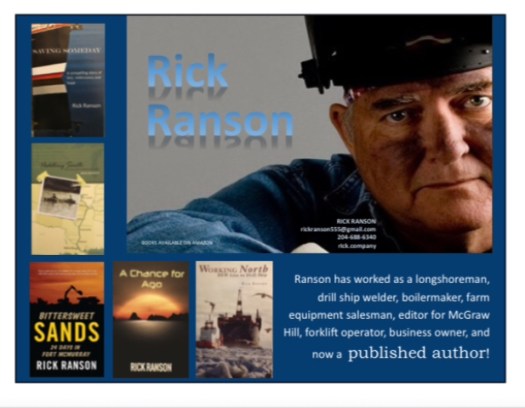
 Rick Ranson